SEO Updates · 8 min read
AI Agents for Business: What They Actually Do (and What They Cost)
 ChatGPT
 Perplexity
 Claude
 Google AI Mode
 Grok
Quick answer — what is an AI agent for business?
An AI agent for business is software given a goal, tools and limits, that works through a job in steps — perceiving, reasoning, acting and checking the result. A chatbot answers. Fixed automation repeats the same steps. An agent decides what to do next, acts in your CRM or inbox, and stops at its limit.
Why is everyone suddenly talking about AI agents?
The search pattern changed in 2026. People stopped asking what AI is and started asking what it can run for them. In a DataForSEO study of 30 AI search terms, published June 2026, task-focused queries fell a median 24%, while agent and automation terms rose a median 31%, drawing about 251,000 US searches a month against about 61,000 for the task terms.
"Agentic AI" averaged about 110,000 US searches a month, up 39% year on year; "AI agents" about 60,500, up 15%. The exact phrase "AI agents for business" is much smaller — about 720 a month on average — but up 210% year on year. Small, fast-growing, commercial: the people typing it are shopping, not browsing.
What is an AI agent, really?
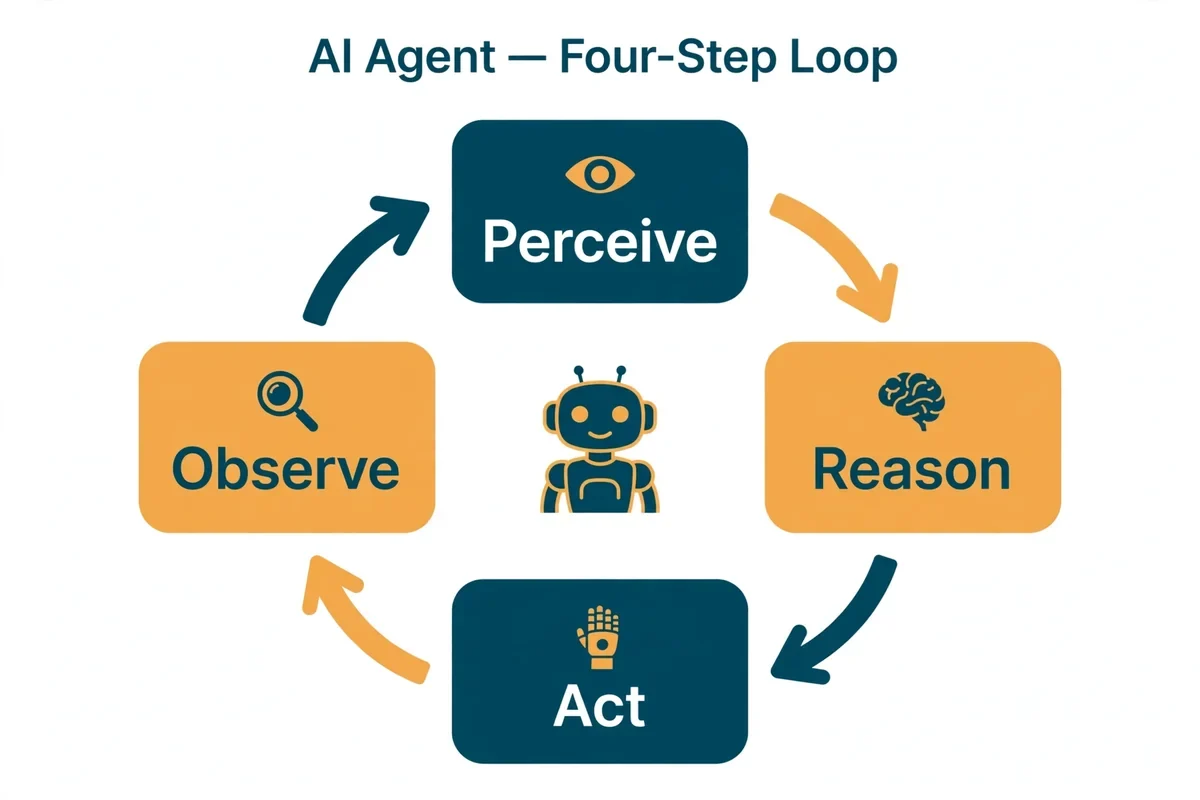
An agent has four parts, in a loop: a goal, a reasoning model, tools, and the loop itself.
A goal is an outcome with boundaries — "qualify this lead and book the ones who are ready" — not a script. A reasoning model is a large language model that reads the situation, breaks the goal into steps, and decides what to do next. Tools are the connections to the systems where work happens: your CRM, inbox, calendar, helpdesk, or a web search. Without tools an agent can only talk. With tools it can act.
The loop is perceive, reason, act, observe — then repeat, until the task is complete or a stopping condition is reached. That condition matters most: a loop with no exit is how an agent sends forty emails or spends your token budget in an afternoon.
How is an agent different from a chatbot or automation?
A chatbot answers. You ask, it replies, the conversation ends. It does not open your CRM and it does not act on what you told it. A good chatbot is useful. It is not an agent.
Fixed automation repeats. A workflow in Zapier, Make or n8n runs the same steps every time: a form is submitted, a row is added, an email is sent. Same input, same output. It is fast, cheap, and easy to audit — and it breaks the moment a task needs judgement. That is the companion article's territory: AI Automation for Small Business.
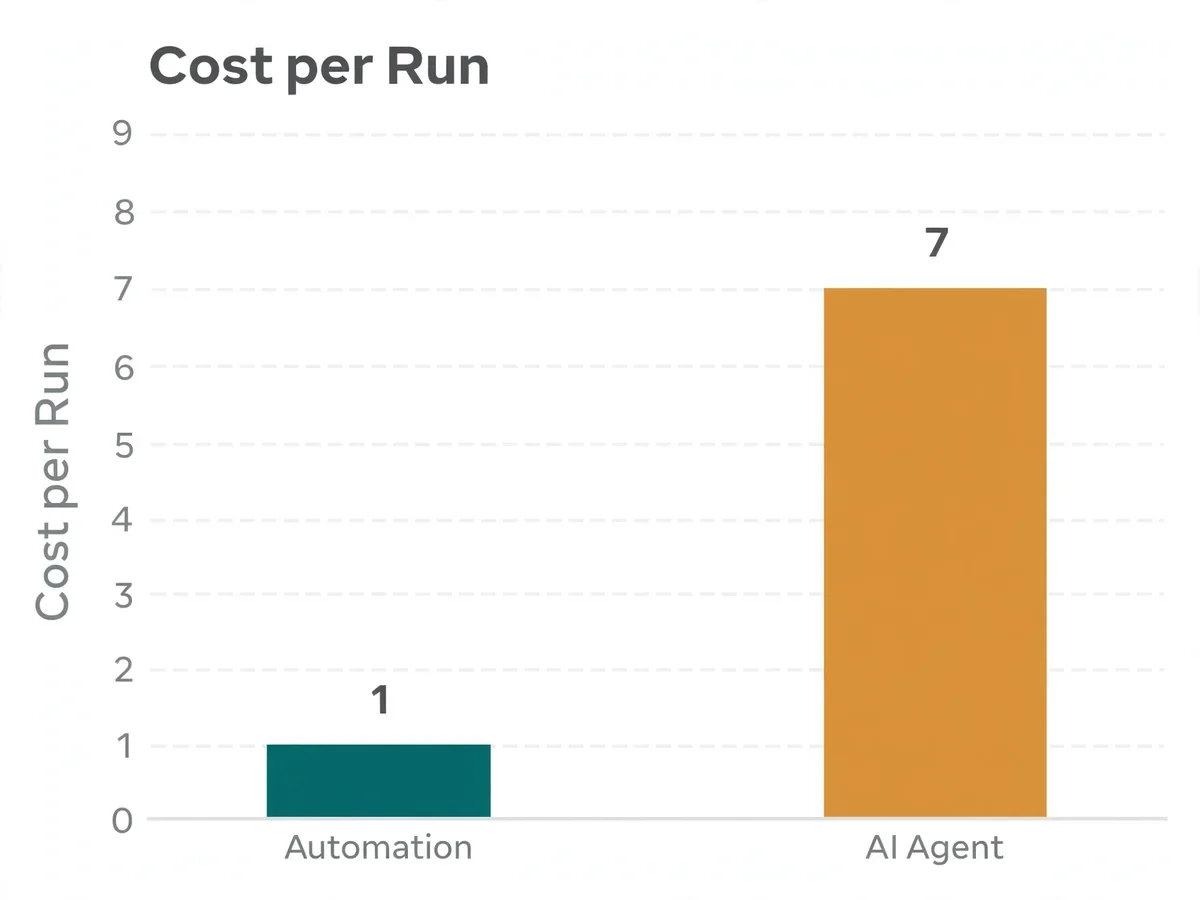
An agent decides. Give it a messy inbox or a lead with half the facts missing, and it reads the situation, chooses a tool, acts, and checks. A deterministic workflow costs fractions of a cent per run. An agent pays for model reasoning on every decision, so a run costs roughly $0.01 to $0.50 or more.
The seven jobs that pay back first
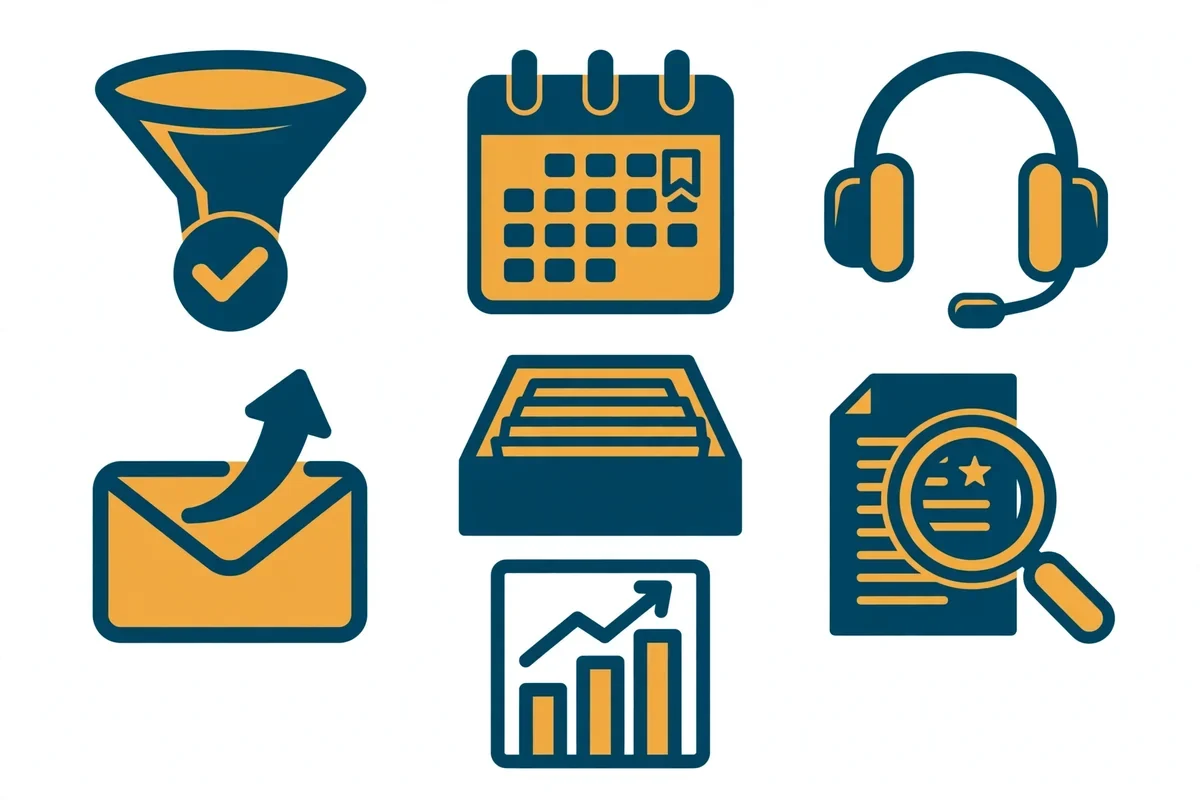
Start with a job that is high-volume, semi-structured, and recoverable if the agent gets it wrong.
- Lead qualification. An agent reads an inbound lead, checks it against your criteria, scores it, and puts the qualified ones in the CRM with a short briefing.
- Appointment scheduling. An agent reads the request, checks the calendar, offers times, books, sends the reminder, and follows up.
- Support triage. An agent reads the ticket, pulls the order context, classifies it, drafts a reply from the approved help centre, and routes it to the right person.
- Sales follow-up. The most common small-business failure is not losing a deal — it is never following up. An agent watches the CRM, notices a quote that went cold, drafts a follow-up, and queues it for approval.
- Inbox triage. An agent reads the inbox, sorts it, drafts replies to the routine half, and flags the urgent and the angry. Start in draft-only mode for two weeks before it sends anything unsupervised.
- Research and briefings. Before a sales call, an agent writes a one-page briefing from the prospect's website and CRM history.
- Daily reporting. Every morning, an agent pulls yesterday's numbers — sales, outstanding invoices, ad spend, support volume — and delivers a short summary with the three figures that moved.
How do you start safely?
Start with one workflow, not a platform. Pick the job above that costs you the most hours or the most lost leads.
Define the goal in one sentence, and the limits in three. What the agent may do, what it must never do, and when it must stop and hand over. "Never send a refund, never change a price, never email a client without approval" is a good start.
Keep a human in the loop for anything irreversible. Money, refunds, cancellations, public replies. The agent drafts; the human approves. Loosen that rule only after a month of clean runs.
Measure the job, not the demo. Write down the baseline before launch: how long does this job take now, how many leads are missed. After thirty days, measure the same numbers. If they have not moved, the agent is a demo, not a tool.
What does it cost?
There are three costs. The build: a proof of concept for one workflow typically runs $5,000–$15,000 done for you; a production agent runs $20,000–$50,000; a multi-agent platform runs $60,000–$150,000 or more. Get the scope in writing before the price. The run: fixed automation costs fractions of a cent per execution, while an agent run costs roughly $0.01 to $0.50 or more. Work out the cost per completed job, not per month. An agent that costs $0.50 to qualify a lead is cheap. One that costs $0.50 to sort an email is not. The keep-alive: the work after launch, when a tool or a document the agent relies on changes. A monthly review — one hour, one person, the error log — is the minimum, or the agent quietly rots.
Here, done-for-you agent work sits inside the Growth plan ($899/month) and the Authority plan ($1,799/month), starting with a free audit.
Where do AI agents fail?
Gartner predicted in June 2025 that over 40% of agentic AI projects would be cancelled by the end of 2027, citing escalating costs, unclear business value, and inadequate risk controls. That is a prediction, not a measurement — it rests on a January 2025 poll of 3,412 webinar attendees — and it describes mostly early experiments driven by hype. Treat it as a warning about how projects are bought, not as a verdict on the technology. A separate May 2026 Gartner prediction — 40% of enterprises demoting an agent already in production — is a different claim; do not mix the two up.
Myths to stop believing
- "An AI agent replaces your team." It replaces a job — one workflow — not a person.
- "If it works in the demo, it works in production." Demos use clean data. Production uses your data. Budget a month of real-world testing.
- "Agents are cheaper than automation." They are not. They cost roughly 10 to 50 times more per run. They earn that cost only where judgement is the work.
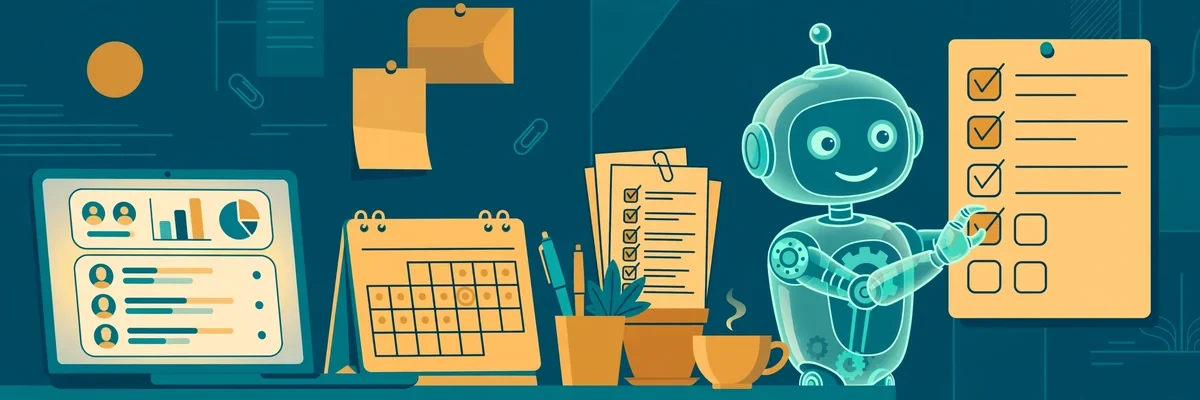
Checklist: before you buy or build
- One job, named? Say in one sentence what the agent will do, and what success looks like in a number.
- Agent or automation? If the steps can be written down and repeated exactly, it is automation, not an agent.
- Limits written? What it may do, what it must never do, and when it hands over — in writing, before launch.
- Tools connected properly? One CRM, one inbox, one calendar, with current data.
- Human approval for irreversible actions? Money, refunds, cancellations, public replies: drafted by the agent, approved by a human.
- Caps set? A maximum number of steps per task and a maximum daily spend.
Frequently asked questions
What is an AI agent for business?
Software given a goal, tools and limits, that works through a job in steps — perceiving, reasoning, acting and checking the result — instead of following a fixed script.
How is an AI agent different from a chatbot?
A chatbot answers a question and the conversation ends. An agent pursues a goal across several steps, uses tools to act on real systems, and checks its own work.
How much does an AI agent cost?
A proof of concept typically runs $5,000–$15,000 done for you; a production agent runs $20,000–$50,000. Running costs are roughly $0.01 to $0.50 or more per task, against fractions of a cent for fixed automation.
Do small businesses actually need AI agents?
Some do, for one job. If leads go unanswered or your inbox is full of routine work, one agent for one job can pay back.
Why do so many AI agent projects fail?
Gartner's June 2025 prediction — over 40% cancelled by the end of 2027 — names three causes: escalating costs, unclear business value, and inadequate risk controls.
What to do next
Pick one job from the seven above — the one that costs you the most hours or the most lost leads. If the steps can be written down and repeated exactly, build automation instead. If the input is messy and the job needs judgement, that is your first agent.
Every engagement starts with a free audit. Request one — it now includes an AI-agent readiness check: which of your workflows is agent work, which is automation work, and what the first one would cost to build and run.

Abu Hosain
Digital Marketing Strategist & White-Hat SEO Expert — 7+ years helping businesses worldwide grow with SEO, AEO and GEO.