
 ChatGPT
 Perplexity
 Claude
 Google AI Mode
 Grok
Quick answer — AEO vs GEO vs SEO in 60 seconds
SEO gets you ranked. AEO makes one passage the direct answer. GEO gets that passage cited inside an AI-written answer. They are three jobs on one foundation, not three separate products. SEO is the foundation: a page that is not indexed cannot be an answer and cannot be cited. AEO is the passage work: a clear, self-contained answer a snippet or an AI system can lift as it stands. GEO is the source work: quotable facts, cited sources and a recognisable entity, so the answer names you.
One honest note first: AEO and GEO overlap heavily, and several recent guides treat them as two names for the same goal. Google's position is blunter still: optimising for its AI features is still SEO. This article keeps them separate only where the work genuinely differs — the passage versus the source.
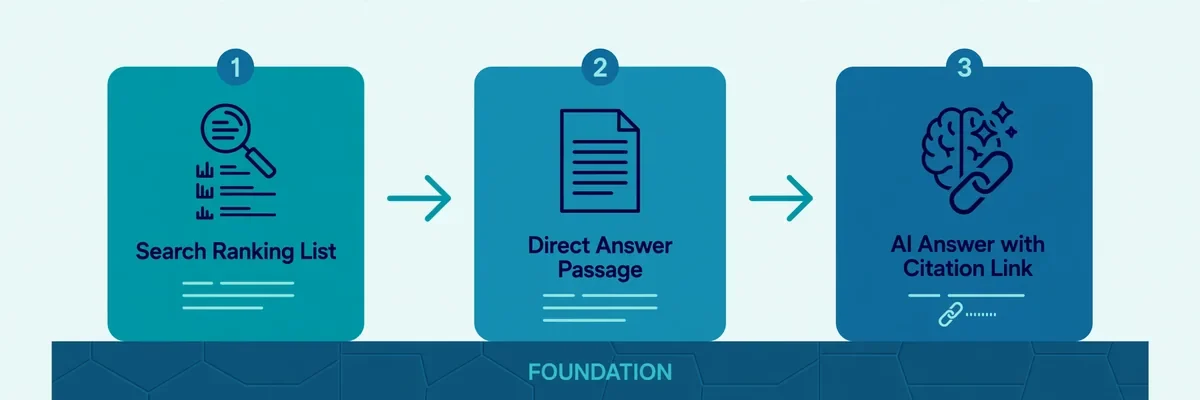
SEO: win the ranking
SEO is the work you already know: making pages crawlable, indexable, relevant and trustworthy so they rank in Google and Bing. What it wins: a position in the classic results, and the click that follows it. It is judged on relevance, authority, technical quality and links, and measured in Search Console. What you optimise: crawlability and indexation, topical coverage, internal links, page experience, and earned links.
Why it comes first: AI answers are built from search results. Google's AI Overviews and AI Mode draw on Google's index; ChatGPT search leans heavily on Bing's index. A page Google has decided not to keep cannot be retrieved by an AI engine, however quotable it is. The GEO pillar put it as a pipeline: SEO gets you into the candidate set.
SEO's limit is also why the other two exist. Pew Research found that when an AI summary appeared, people clicked a normal result on just 8% of visits, against 15% with no summary. Ahrefs found position-1 click-through fell 34.5% when an AI Overview appeared, and 58% in its February 2026 update. Ranking still matters. It no longer guarantees being seen.
AEO: win the direct answer
AEO is the passage work. It formats content so one passage can be lifted, whole, as the direct answer: a featured snippet, a People Also Ask box, a voice-assistant reply, or the opening of an AI Overview.
What it wins: being the answer, not one of ten blue links. It is judged on whether one clear passage answers the question on its own. What you optimise: question research, concise answer blocks, FAQ structure, and entity-clear writing. In practice: name the question in the heading, answer it in the first two sentences, then explain below. Keep one idea per section.
AEO is the oldest of the three terms — it began with voice assistants and featured snippets — and today it mostly means the same work as GEO. The difference that remains is focus: AEO cares about the passage, GEO cares about the source. A perfect AEO passage with no author, no source and no identifiable business behind it can be used without ever being credited. That is the gap GEO closes.
GEO: win the citation inside the AI answer
GEO is the source work. It makes your content easy for ChatGPT, Perplexity, Google AI Overviews and AI Mode, Claude and Copilot to find, trust and cite inside a synthesised, multi-source answer.
What it wins: a mention or a citation — your name in the answer text, your URL as a source — rather than a ranking alone. It is judged on whether your passage is among the few selected to build the answer. The GEO pillar describes this as three gates: retrieval, selection, citation. Fail any one and you are not cited.
What you optimise: quotable facts, statistics and quotations with named sources; clear authorship and a consistent entity (same name, services and facts on your site, Google Business Profile, LinkedIn and directories); crawler access for AI search bots such as OAI-SearchBot and PerplexityBot; and mentions on sites you do not own.
The Princeton GEO study — the paper the term comes from — found that adding quotations, statistics and cited sources raised a page's share of an AI answer by roughly 30–40% in the lab, while keyword stuffing did worse than nothing. Read honestly: those figures measure share of an answer's text, not traffic, and only tested pages already in the top five. No one can guarantee a citation, and this site does not claim otherwise.
The comparison table
| Wins | Where it shows | Judged on | You optimise | Measured in | Without it | |
|---|---|---|---|---|---|---|
| SEO | A ranking in the classic results. | Google and Bing results. | Relevance, authority, technical quality, links. | Crawlability, indexation, topical coverage, internal links. | Rankings, clicks (Search Console). | The page is never retrieved. |
| AEO | The direct answer. | Snippets, People Also Ask, voice answers. | Whether one passage answers the question alone. | Question research, answer blocks, FAQ structure. | Snippet appearances. | Your answer cannot be lifted as it stands. |
| GEO | A citation inside an AI answer. | ChatGPT, Perplexity, Gemini, Copilot, AI Overviews. | Whether your passage is selected and credited. | Quotable facts, entity clarity, mentions. | Citations in a prompt panel; AI referrals in GA4. | You are used but never named. |
A Dhaka example: one page, three jobs
Take a Dhaka dental clinic in Dhanmondi. A customer asks: "best dentist in Dhanmondi for root canal".
SEO decides whether the clinic's page is indexed, ranks for "dentist Dhanmondi", loads fast on a phone, and links to its price and booking pages. Without that, the page does not exist for any engine.
AEO decides whether the page answers directly: "A root canal at our Dhanmondi clinic costs BDT X–Y, takes two visits, and…" — in the first two sentences, under a heading that asks the question.
GEO decides whether the answer names that clinic: the passage carries a named dentist, a sourced figure, and the same clinic name, address and services on its Google Business Profile and directories. A competitor with the same passage but no identifiable source gets used; the clinic with the source gets cited.
Same page. Three jobs — in that order: fix indexation first, then make the page answer-first, then add the sourced facts that earn the citation.

What to stop paying for
- Three separate packages for SEO, AEO and GEO. The work overlaps by design — indexation, answer-first writing and sourced facts are one editorial job, not three retainers. Google treats AI optimisation as SEO; Microsoft has said the same about GEO.
- llms.txt as a citation trick. Google is explicit: no new file is needed for AI Overviews or AI Mode.
- Special "AI schema". There is no special schema.org markup for AI features. Standard Article and FAQPage schema that matches the visible text is enough.
- Keyword stuffing. The Princeton study measured it as worse than doing nothing — it makes passages less quotable, not more.
- Bought or planted mentions. Seeking inauthentic mentions to influence what AI says about you is, in Google's words, not likely to be helpful — and it breaks the white-hat rule this site works by.
Which one do you need first? A short checklist
Answer these in order. The first "no" is where to start.
- SEO — are your key pages indexed? Check each one in Search Console's URL Inspection tool, in Google and in Bing. If a page is not indexed, nothing else matters yet.
- SEO — is anything blocking a snippet? A noindex, nosnippet or max-snippet:0 rule keeps a page out of AI Overviews entirely. Check the page source and Search Console (Settings > Search generative AI — include is the default).
- AEO — does each key page answer its main question in the first two sentences? If the answer is buried in paragraph four, rewrite the opening, not the whole page.
- GEO — does each key claim carry a number, a quotation or a linked primary source? Replace "many businesses" with a real, sourced figure.
- GEO — can an engine identify you? Named author, credentials, About page, and identical business facts on your site, Google Business Profile, LinkedIn and directories.
- Measurement — are you tracking citations, not just rankings? A monthly panel of 20–30 buyer questions, asked in ChatGPT, Perplexity and Google on the same day each month. AI referrals in GA4; AI Overview impressions in Search Console's Generative AI report.
Frequently asked questions
What is the difference between AEO, GEO and SEO?
SEO wins a ranking in classic search results. AEO makes one passage the direct answer. GEO gets that passage cited inside a synthesised AI answer. They stack: SEO first, then the passage, then the source. AEO and GEO overlap heavily, and Google considers optimising for AI features to be SEO.
Is GEO different from AEO, or the same thing?
Mostly the same goal, different emphasis. AEO focuses on the passage — a clear, self-contained answer that can be lifted. GEO focuses on the source — quotable facts, cited sources, crawler access and a recognisable entity, so the answer names you. In practice, good AI-search work does both at once.
Can I appear in Google AI Overviews without GEO?
Yes. Google says a page must be indexed and eligible to show a snippet, with no additional technical requirements and no special markup or files. That eligibility is SEO. What GEO adds is the quotable passage and the entity signals that make your page the one the Overview links to, rather than a competitor's.
How long does AEO or GEO take to work?
Indexation and snippet fixes can make a page eligible within days. Citations build over weeks to months as engines re-crawl and your content earns mentions. A realistic first checkpoint is a 90-day prompt-panel comparison against your baseline — the same measurement the GEO pillar sets out — not a ranking report after one week.
What to do next
Do the jobs in order: get indexed, make your best page answer-first, then add the sourced facts that earn a citation. Already ranking but never cited? Skip to the GEO checklist — your problem is almost certainly the source, not the ranking.
Every engagement starts with a free audit. Request one — it now includes an AI-visibility check: crawler access, Bing and Google indexation, and a 10-prompt citation test.

Abu Hosain
Digital Marketing Strategist & White-Hat SEO Expert — 7+ years helping businesses worldwide grow with SEO, AEO and GEO.